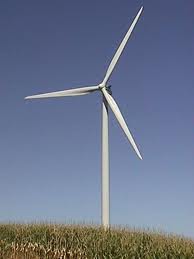
Broken Wind Turbine Blades Create Mountainous Waste Problem - June 12th,
Ultra-green Denmark admits it has no idea what to do with a worrisome mountain of old and broken wind turbine blades. The composite material can’t be recycled. In a story from Denmark’s leading business newspaper Dagbladet Børsen (June 10, 2011) experts warn, “As the wind becomes a central part of energy supply, a huge waste problem is growing with similar speed.” Windy Scandinavia has hit this unanticipated hurdle because a key material in constructing wind turbines, carbon fibre composite, cannot be recycled and is fast filling landfills or else is being burned creating toxic emissions. The report admits, “a gigantic mountain of scrap blades is building up.”
Tom Løgstrup Andersen from Risø DTU, a senior development engineer who has spent two decades researching fiberglass composites admits, "When a turbine is operating, it produces green energy. But when it is worn, it is suddenly a problem. There exists no concrete solution to reusing blades from wind turbines.”
Poor Planning, Poor Technology Defeats Renewables Goal - Denmark has 6,000 wind turbines serving a population of 5.3 million and when the wind conditions are just right wind produces a mere 19 percent of its electricity. Yet despite huge financial investment no conventional power plant has yet been shut down while Danish electricity costs to consumers are the highest in Europe, according to research by energy specialist, Dr. Vic Mason.
Turbine blades routinely exceed 60 meters in length and nearly all are manufactured from thermoset plastics that cannot be recycled once their useful life has expired. The special plastic is the only material currently known that meets reliability standards due to their relatively high strength and low weight properties.
Dr. Mason cites evidence that many small turbines have collapsed in close proximity to human dwellings [1; 2; 3], and recently two big Danish wind turbines lost blades and scattered sharp pieces of carbon fibre up to 500 meters from the tower base in high winds [4.]. Similar events have also been reported in Sweden, northern England and Scotland [5.]. Blade failure can be lethal and catastrophic as shown by video footage.
Ultra-green Denmark admits it has no idea what to do with a worrisome mountain of old and broken wind turbine blades. The composite material can’t be recycled. In a story from Denmark’s leading business newspaper Dagbladet Børsen (June 10, 2011) experts warn, “As the wind becomes a central part of energy supply, a huge waste problem is growing with similar speed.” Windy Scandinavia has hit this unanticipated hurdle because a key material in constructing wind turbines, carbon fibre composite, cannot be recycled and is fast filling landfills or else is being burned creating toxic emissions. The report admits, “a gigantic mountain of scrap blades is building up.”
Tom Løgstrup Andersen from Risø DTU, a senior development engineer who has spent two decades researching fiberglass composites admits, "When a turbine is operating, it produces green energy. But when it is worn, it is suddenly a problem. There exists no concrete solution to reusing blades from wind turbines.”
Poor Planning, Poor Technology Defeats Renewables Goal - Denmark has 6,000 wind turbines serving a population of 5.3 million and when the wind conditions are just right wind produces a mere 19 percent of its electricity. Yet despite huge financial investment no conventional power plant has yet been shut down while Danish electricity costs to consumers are the highest in Europe, according to research by energy specialist, Dr. Vic Mason.
Turbine blades routinely exceed 60 meters in length and nearly all are manufactured from thermoset plastics that cannot be recycled once their useful life has expired. The special plastic is the only material currently known that meets reliability standards due to their relatively high strength and low weight properties.
Dr. Mason cites evidence that many small turbines have collapsed in close proximity to human dwellings [1; 2; 3], and recently two big Danish wind turbines lost blades and scattered sharp pieces of carbon fibre up to 500 meters from the tower base in high winds [4.]. Similar events have also been reported in Sweden, northern England and Scotland [5.]. Blade failure can be lethal and catastrophic as shown by video footage.
Indeed, the death toll from wind turbines in recent decades is huge when compared with nuclear accidents. In 2008 in the U.S. alone there were 41 worker fatalities and 16 non-worker deaths. As the film shows, ironically, in high winds the turbines must be stopped because they are easily damaged. Carbon fibre has been the material of choice because of lightness and efficiency of construction. But the stress damage to fibre composites is poorly understood to begin with and wear and tear on blades can be considerable. Also, over time a build-up of dead bugs, plus other wear and tear reduces the power generated by 20 to 30 percent. So for safety and efficiency the blades must be regularly replaced.
Europe Fears Toxic Waste Wind Turbine Mountain - Currently the global market for wind turbine blades is growing at over 10 percent growth per annum and worth around US$2 billion a year. But shortsighted thinking has lead to a situation where the greatest challenge now is to develop a profitable and safe recycling process for the unwanted carbon fibre blades. Since 2004, most European Union (EU) member states passed laws forbidding landfill disposal of carbon fibre composites. Further, incineration of plastics is discouraged because of the potential release of toxic byproducts.
Professor Henning Albers from the Institut für Umwelt und Biotechnik, Hochschule Bremen, calculates that at current growth rates by 2034, there will be a mountain of 225,000 tonnes of unwanted rotor blade material waste EACH YEAR. That’s a lot of landfill!
Investors Bail out of Renewables Sector. The aircraft industry, a long-time user of composite plastics has, itself, had little success in solving the landfill problem. The aviation industry has tried to minimize landfill tipping by grinding down the thermoset composites into granules for use as filler materials (e.g., in asphalt). But there isn’t a commercial market for such waste. A report by Compositesworld.com agrees, “a major cost barrier in composites recycling is that collected composite waste must be sorted — one of the more labour-intensive aspects of conventional recycling processes.”
Summing up the lack of forward planning about wind turbines physicists and environmental activist, John Droz, jr, warns, “just because a power source is an alternative, or a renewable, does NOT automatically mean that it is better than any conventional or fossil fuel source.”
http://johnosullivan.livejournal.com/
References:
[1.] B.B., 2000: “Vindmølle lækkede olie. Kollapset vindmølle ved Rærup erstattes snart af ny”. “[Wind turbine leaked oil. Collapsed turbine near Rærup will soon be replaced by a new one]”. Nørresundby Avis, 09-02-2000.
[2.] Bülow, T., 2001: “Exit Tjærborg”. Eltra magasinet, August 2001.
[3.] Ritzau, 2005: “Vindmølle mistede sine vinger”. “[Wind turbine lost its blades]”. Jyllands-Posten, 21-01-2005.
[4.] LiveLeak, 2008: “Windmill out of control” (Video of wind turbine exploding).
[5.] Krøyer, K., 2008: “Endnu en Vestas-mølle kastede vinge 100 meter væk i blæsten”. “[Yet another Vestas wind turbine throws its blade 100 metres in the wind]”. Ingeniøren, 25-02-2008
Europe Fears Toxic Waste Wind Turbine Mountain - Currently the global market for wind turbine blades is growing at over 10 percent growth per annum and worth around US$2 billion a year. But shortsighted thinking has lead to a situation where the greatest challenge now is to develop a profitable and safe recycling process for the unwanted carbon fibre blades. Since 2004, most European Union (EU) member states passed laws forbidding landfill disposal of carbon fibre composites. Further, incineration of plastics is discouraged because of the potential release of toxic byproducts.
Professor Henning Albers from the Institut für Umwelt und Biotechnik, Hochschule Bremen, calculates that at current growth rates by 2034, there will be a mountain of 225,000 tonnes of unwanted rotor blade material waste EACH YEAR. That’s a lot of landfill!
Investors Bail out of Renewables Sector. The aircraft industry, a long-time user of composite plastics has, itself, had little success in solving the landfill problem. The aviation industry has tried to minimize landfill tipping by grinding down the thermoset composites into granules for use as filler materials (e.g., in asphalt). But there isn’t a commercial market for such waste. A report by Compositesworld.com agrees, “a major cost barrier in composites recycling is that collected composite waste must be sorted — one of the more labour-intensive aspects of conventional recycling processes.”
Summing up the lack of forward planning about wind turbines physicists and environmental activist, John Droz, jr, warns, “just because a power source is an alternative, or a renewable, does NOT automatically mean that it is better than any conventional or fossil fuel source.”
http://johnosullivan.livejournal.com/
References:
[1.] B.B., 2000: “Vindmølle lækkede olie. Kollapset vindmølle ved Rærup erstattes snart af ny”. “[Wind turbine leaked oil. Collapsed turbine near Rærup will soon be replaced by a new one]”. Nørresundby Avis, 09-02-2000.
[2.] Bülow, T., 2001: “Exit Tjærborg”. Eltra magasinet, August 2001.
[3.] Ritzau, 2005: “Vindmølle mistede sine vinger”. “[Wind turbine lost its blades]”. Jyllands-Posten, 21-01-2005.
[4.] LiveLeak, 2008: “Windmill out of control” (Video of wind turbine exploding).
[5.] Krøyer, K., 2008: “Endnu en Vestas-mølle kastede vinge 100 meter væk i blæsten”. “[Yet another Vestas wind turbine throws its blade 100 metres in the wind]”. Ingeniøren, 25-02-2008